
 Emergencies
 01909 472 059
What is a Laparoscopic Spay?
A laparoscopic spay, also known as a laparoscopic ovariectomy or keyhole spay, is a minimally invasive surgical procedure in which only the ovaries are removed from a female dog using a laparoscope. This contrasts with a traditional ovariohysterectomy, where both the ovaries and the uterus are removed through a larger abdominal incision.
How is a Laparoscopic Spay Performed?
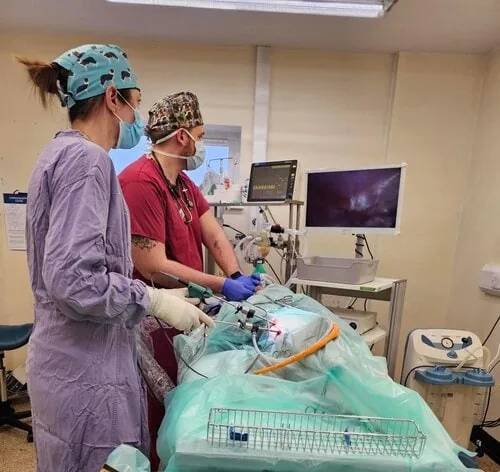
A small needle is inserted into the abdomen, which is then inflated with carbon dioxide gas. This creates a working space, providing better visibility and room for the surgical instruments.
Two small cannulas (tubes) are placed through tiny incisions in the abdominal wall as access points. One cannula is for the camera and the other is for surgical instruments to pass through.
The camera provides a magnified view of the internal organs on an external monitor allowing for precise navigation. The ovaries are located, the blood vessels are cauterised (sealed) to prevent bleeding and then removed through the cannula. The abdomen is deflated, and the incisions are closed with sutures or surgical glue.
Main Advantages of Laparoscopy Spays
- Less invasive day patient procedure
- Smaller incisions result in less trauma and quicker healing
- Reduced risk of complications during surgery
- Faster recovery and return to normal activities sooner
- Less bleeding
- Less postoperative pain
- More precise
Comparison Summary
| Category | Laparoscopic Spay | Traditional Spay |
|---|---|---|
| Anaesthetic Risks | Shorter surgery duration | Longer duration |
| Cost | Higher | Lower |
| Incision Size | Smaller | Larger |
| Infection Risk | Lower (smaller incisions) | Higher (larger incision) |
| Postoperative Pain | Less | More |
| Precision | Higher due to magnified view | Standard visual field |
| Procedure | Removal of ovaries only | Removal of ovaries and uterus |
| Recovery Time | Faster | Slower |
| Complications | Lower | Higher |
| Uterine Disease | Risk eliminated | Risk eliminated |
Why Do We Only Remove the Ovaries and Not the Uterus?
Hormonal Control: Removing the ovaries eliminates the source of hormones that trigger heat cycles and associated behaviours.
Uterine Health: Without the ovaries, the uterus no longer receives hormonal stimulation, eliminating the risk of uterine diseases like pyometra.
In addition, there is no benefit to removing the uterus during routine neutering of healthy female dogs. The longer-term health outcomes for both ovariohysterectomy and ovariectomy are the same.
The only scenario where the uterus may need removing would be in older dogs (>8 years old), where there is an increased risk of abnormal changes in the uterus (this will be discussed at the admission appointment).
It is possible to convert to a traditional spay if complications arise, however this rarely necessary.
Why Keyhole Spays Cost More
- Advanced Technology: Surgical instruments used for laparoscopic spays include laparoscopes, cameras and high-definition monitors. Compared to traditional surgery, these tools are significantly more expensive.
- Specialised Training: In order to perform laparoscopic surgery, veterinarians undergo extensive additional training.
- Preparation: Laparoscopic procedures take more time to set up and calibrate than traditional spays.
- Sterilisation: In laparoscopic procedures, sophisticated instruments need to be sterilised thoroughly.
Minimising Risks
To minimise risks, it is crucial to:
- Follow Preoperative Instructions: Adhere to all pre-surgical instructions provided by the vet or nurse, including fasting and medication guidelines.
- Provide Proper Postoperative Care: Follow all postoperative care instructions, including activity restriction for 5 days, incision care, and monitoring for signs of complications.
- Schedule Follow-Up Visits: Attend all recommended follow-up appointments to ensure your pet is healing properly.
We are dedicated to providing the best care for your pets and as a practice, we are proud to offer this advanced technique alongside traditional neutering. Our team is here to help you make informed decisions about your dog's health and well-being.
Lap Spay - Refer Online